A 13-card example
In a common Indian Rummy format, a valid hand contains at least two sequences, including one pure sequence. All other cards must also form valid groups. Rules can vary by table.
ONE WAY TO ARRANGE 13 CARDS
These four groups use every card once: 3 + 4 + 3 + 3 = 13. Both sequences are pure in this example; each set has one rank in different suits. Check the selected table’s joker and declaration rules.
Learn pure and impure sequencesHow a 13-card turn works
- 01
Sort the opening hand
Look for cards that could form consecutive runs of the same suit. Set aside possible groups of the same rank; keep all 13 cards accounted for.
- 02
Pick one card
On a turn, take the available card from the open pile or draw from the closed pile, according to the table rules.
- 03
Discard one card
Choose one card to place on the discard pile. You should be back to 13 cards after your turn; the discarded card is visible to the table.
- 04
Check every group
Before declaring, check for two sequences, including a pure sequence, and ensure each remaining card belongs to a valid sequence or set. Confirm the selected table’s conditions.
Sequences, sets and a declaration
Pure sequence
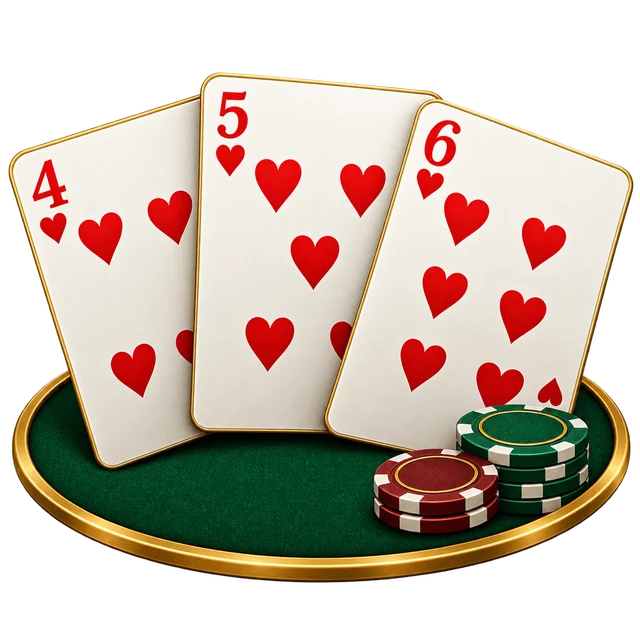
For example, 5♥ 6♥ 7♥ are consecutive hearts. None of these cards is acting as a substitute.
Impure sequence
A missing card in a same-suit run can be represented by a permitted joker. The table’s rules determine which jokers can be used.
Set
A set groups the same rank across different suits, such as 4♣ 4♦ 4♠. Two copies of the same suit do not make a valid set.
Complete hand
The 13 cards must all fit into valid groups; a common Indian Rummy declaration needs at least two sequences and one must be pure.
For a complete worked arrangement, see the 13-card example above. For a closer look at jokers, read pure and impure sequences.
How common formats differ
Points
A deal is settled using the score and point value set for that table. Check how ungrouped cards and an invalid declaration are scored.
Pool
Scores carry across deals and the table sets an elimination threshold. Check the limit and any re-entry rules before joining.
Deals
A fixed number of deals is played. Review how the table starts each player, scores each deal and decides the final result.
These are explanations of common formats, not a list of formats guaranteed to be available in the app.
A practical hand-check routine
- Find a possible pure sequence first; a joker used as a substitute cannot make that group pure.
- Keep the suits visible when sorting runs and check the rank and suit of each card in a set.
- Before choosing a discard, consider whether it is the only card connecting a possible sequence.
- Before declaring, count all groups back to 13 and read the table’s declaration conditions.
No sorting approach guarantees a win. Set a time and spending limit before playing.
What to check before joining
Look at the selected format, entry conditions, turn timer and scoring explanation. In a points game, check how points are valued; in a pool or deals game, check how results carry across hands.
Availability and rules depend on the table. Set a limit in advance, and do not increase spending to recover a loss. See responsible gaming for more guidance.
Table rules and scoring
Before joining, read the selected table’s rules for scoring, declaration, drops and how jokers are treated. Formats can use different conditions, so check the information displayed for the game you choose.
Mistakes to catch before a show
- A run with a substituted joker is counted as pure.
- Two cards of the same rank and suit are placed in one set.
- A card appears in two groups, leaving another card ungrouped.
- A hand is declared before the second sequence is complete.
Master Rummy glossary
- Drop
- Leaving a deal under the table’s stated drop rules.
- Wild joker
- The selected rank that can substitute for another card.
- Meld
- A valid group of cards: a sequence or a set.
- Deadwood
- Cards that are not part of a valid group.
- Show
- Submitting your arranged hand for validation.