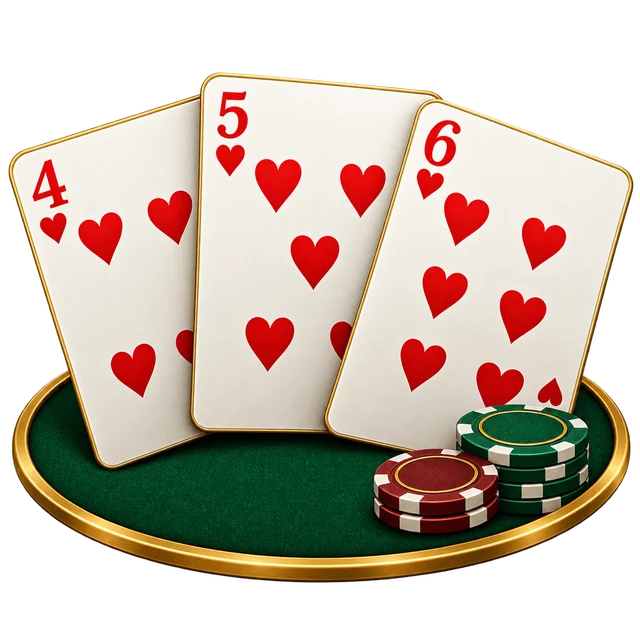

A three-card comparison
Consider A♠ A♥ A♣ and K♠ K♥ K♦. Both are trails: three cards of one rank. In a standard high-hand comparison, the higher-ranked trail wins. This illustration explains the ranking; check the chosen table for variation and tie rules.
Start with the full hand order, then read the hand comparison guide.
How a Teen Patti round unfolds
- 01
Read the table
Check the contribution, turn timer, permitted stakes and whether the standard hand order applies.
- 02
Receive three cards
A blind player acts without looking at the hand; a seen player has viewed it. The table explains how this affects permitted stakes.
- 03
Make a decision
On your turn, follow the available actions shown at the table. Folding ends your participation in that hand.
- 04
Resolve the hand
If a show takes place, eligible hands are compared under the selected variation’s ranking and tie rules.
Standard hand order
Trail / trio
Three cards of one rank, such as three queens.
Pure sequence
Three consecutive cards of the same suit.
Sequence
Three consecutive cards that are not all the same suit.
Colour / flush
Three cards of one suit that do not form a pure sequence.
Pair
Two cards of the same rank and a third card of another rank.
High card
A hand without the combinations above, compared according to the table’s card-order rules.
The list is ordered from stronger to weaker for standard rules. Variants can change it; check whether the table uses special ace or tie-breaking rules.
Check the variation first
Standard
Hands follow the ordinary ranking shown above. Review any rules for comparing equally ranked hands.
Joker games
A designated card or rank can act as a substitute. Which cards are wild and how they affect a hand depend on the variation.
Muflis
The usual strength order is reversed. Read the specific table’s comparison and tie rules rather than assuming standard rankings.
Examples describe common rules and do not confirm that every variation is available.
Before deciding at the table
- Learn the hand order before making a stake decision.
- Check the permitted blind and seen actions and read the round timer.
- Decide your time and spending limits in advance.
- Do not continue a hand merely to recover an earlier loss.
Read the table conditions
The boot, blind and seen stakes, sideshow availability and turn timer can differ between tables. The game should show which actions are available and when a show is permitted.
Check the terms for the selected table before joining; the examples here do not set an entry amount or establish which variations are available.
How fairness works in Master TeenPatti
Read the current variant’s shuffle, ranking and stake rules. A general guide does not establish the app’s testing or operational controls.
Common hand-reading mistakes
- Treating three cards of the same suit as a pure sequence when their ranks are not consecutive.
- Applying the standard ranking to a variation that changes the order.
- Assuming a sideshow is available without checking the current table.
- Continuing solely because of an earlier loss.
Master TeenPatti glossary
- Boot
- The initial contribution required by a table.
- Blind
- Playing without seeing your cards.
- Seen
- Playing after viewing your cards.
- Sideshow
- A permitted comparison with another eligible hand.
- Show
- A final hand comparison under the table rules.